
Understanding the IEC 61508 Functional Safety Lifecycle – Part 1

24 Aug 2026
What is the Functional Safety Lifecycle?
Functional safety is often discussed in terms of SIL targets, redundancy, diagnostics or software development techniques. In reality, however, none of these elements exist in isolation. IEC 61508 was intentionally developed around the idea that functional safety must be managed as a complete lifecycle – beginning long before any hardware or software is designed and continuing long after a product or system has been placed into operation.
This lifecycle approach is one of the defining characteristics of IEC 61508 and remains one of the area’s most commonly misunderstood by organisations beginning their functional safety journey. Many projects focus heavily on the “realisation” phase – the actual development of hardware and software – while overlooking the earlier lifecycle activities that fundamentally determine whether the safety concept is robust in the first place.
The IEC 61508 Functional Safety Lifecycle provides the framework used to manage safety-related systems from initial concept through to decommissioning. It defines how hazards are identified, how safety functions are specified, how integrity requirements are allocated, and how evidence is generated throughout the lifecycle to demonstrate that risks have been reduced to an acceptable level.
The Purpose of the Functional Safety Lifecycle
IEC 61508 applies to electrical, electronic and programmable electronic (E/E/PE) safety-related systems. These systems may exist within industrial machinery, process plants, robotics, energy storage systems, autonomous equipment, transportation infrastructure and countless other modern technologies.
The standard recognises that dangerous failures rarely occur because of a single isolated issue. Instead, failures are often the result of weaknesses introduced across multiple lifecycle stages:
- incomplete hazard identification
- poorly defined safety requirements
- inadequate architectural design
- software systematic faults
- insufficient verification
- weak change management, or
- poor operational maintenance
The lifecycle model exists to ensure that safety is considered continuously and systematically across all of these activities. Rather than treating safety as a final testing exercise, IEC 61508 requires organisations to demonstrate that safety has been planned, managed, verified and validated throughout the entire development process.
The Overall IEC 61508 Functional Safety Lifecycle
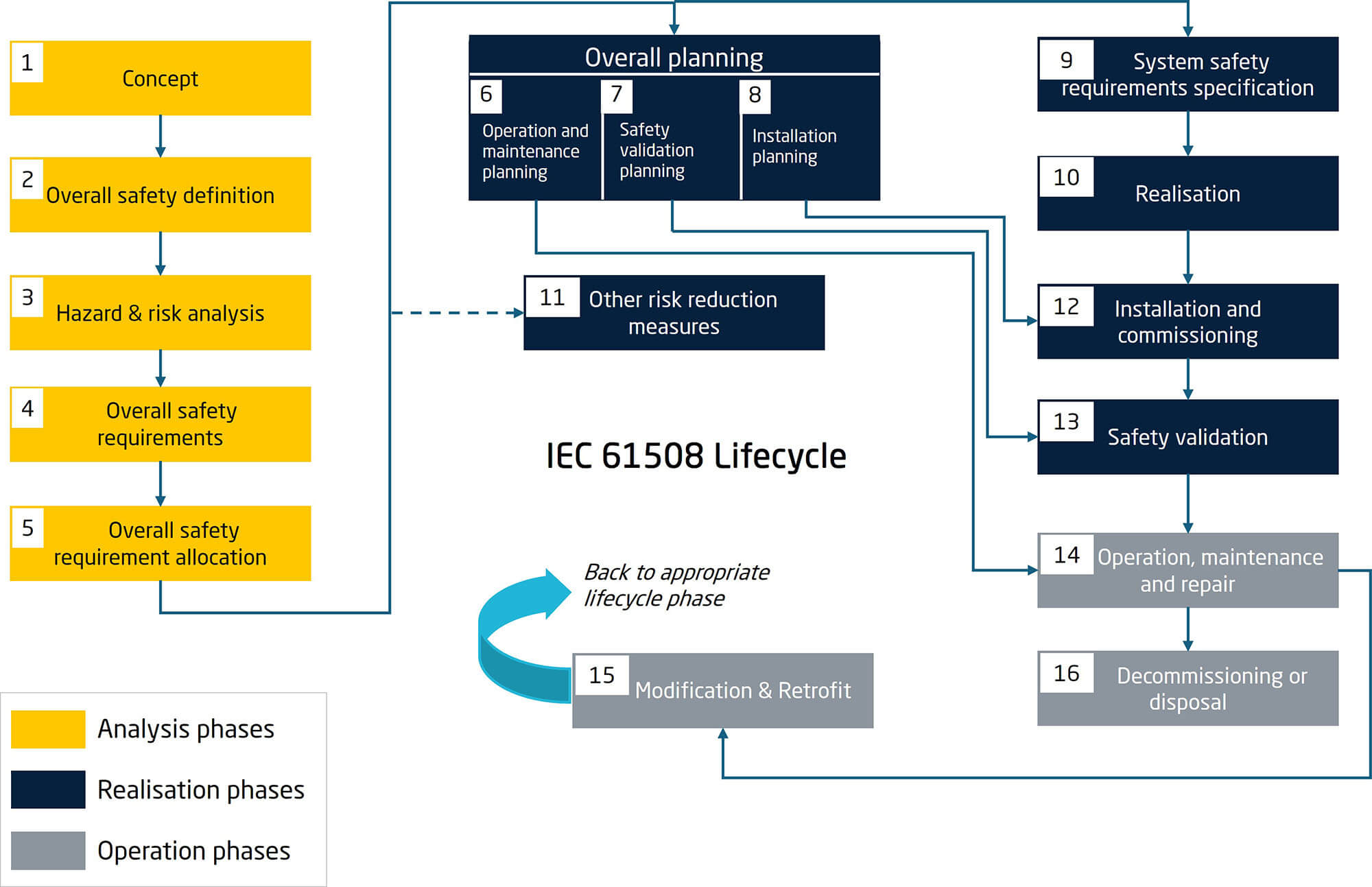
The standard defines an overall safety lifecycle that begins with concept development and hazard analysis before eventually progressing through design, implementation, operation and decommissioning.
A simplified view of the lifecycle typically includes:
- Concept
- Overall scope definition
- Hazard and risk analysis
- Overall safety requirements
- Safety requirements allocation
- Overall operation and maintenance planning
- Safety-related systems realisation
- Installation and commissioning
- Validation
- Operation, maintenance and modification
- Decommissioning
One of the most important observations is that the lifecycle does not end once the product is released or commissioned. IEC 61508 places significant emphasis on maintaining functional safety throughout operational life, including modification control, proof testing, incident management and competency management. This is particularly important because many safety incidents occur after changes are introduced to otherwise compliant systems.
The ‘Realisation’ Stage
A common misconception is that IEC 61508 is simply a hardware reliability standard or a software development standard. In reality, it is much more. The key transition point occurs during the safety-related systems realisation phase - lifecycle phase 10.
Once the earlier lifecycle stages have established:
- the hazards,
- required safety functions,
- Safety Integrity Level (SIL) targets, and
- system safety requirements,
the lifecycle then branches into dedicated technical realisation activities.
This is where IEC 61508 separates into:
- IEC 61508-2 for hardware safety lifecycle activities, and
- IEC 61508-3 for software safety lifecycle activities
These two parts operate in parallel but remain tightly linked through the overall safety requirements specification.
Why the Lifecycle Structure Matters
Understanding how IEC 61508 transitions from the overall lifecycle into hardware and software realisation is critical because it explains how functional safety projects are actually structured in practice. Too often, organisations attempt to begin with hardware calculations or software coding before:
- defining hazards
- allocating safety functions
- establishing SIL targets, or
- developing a robust Safety Requirements Specification (SRS)
This frequently leads to redesigns, gaps in evidence, inconsistent assumptions and expensive late-stage corrections. IEC 61508 intentionally forces organisations to establish the safety foundation first before moving into technical implementation.
In many ways, the standard can be viewed as:
- Part 1 = functional safety management and lifecycle framework
- Part 2 = hardware realisation framework
- Part 3 = software realisation framework
Final Thoughts
The IEC 61508 Functional Safety Lifecycle is far more than a process diagram within a standard. It is the backbone of how modern safety-related systems are developed, verified and maintained. Understanding the lifecycle, particularly the transition from overall safety management into hardware and software realisation, is essential for anyone involved in functional safety projects.
In the next blog within this series, we will explore the early lifecycle phases in greater detail, including how hazards and risks are identified, how safety functions are defined, how SIL targets are determined, and how the Safety Requirements Specification (SRS) is developed.
These early phases ultimately determine whether the remainder of the lifecycle is built upon a strong engineering foundation or unstable assumptions that can create significant safety and compliance challenges later in the project lifecycle.

Entire Blog Series

24 Aug 2026
Understanding the IEC 61508 Functional Safety Lifecycle – Part 1
What is the Functional Safety Lifecycle?
31 Aug 2026
Understanding the IEC 61508 Functional Safety Lifecycle – Part 2
The Starting Point: Hazard and Risk Assessment
09 Sep 2026
Understanding the IEC 61508 Functional Safety Lifecycle – Part 3
Safety Requirements and System Design
14 Sep 2026
Understanding the IEC 61508 Functional Safety Lifecycle – Part 4
Verification, Validation, and the Evidence Problem
21 Sep 2026
Understanding the IEC 61508 Functional Safety Lifecycle – Part 5
Functional Safety Does Not End at Product Release
You may be interested in...
IEC 61508: The Functional Safety Standard
IEC 61508 is an international standard that provides a framework for ensuring the functional safety of systems that depend on electrical, electronic, or programmable electronic (E/E/PE) technologies.

Functional Safety Testing & Certification
From early design stages through to production, our modular FS solutions provide flexible options for manufacturers, and our FS Mark provides stakeholders with visibility for products they purchase, install, or utilize in operations.